



About the Plant

It is also found in Hawaii, China, India, Australia, and Africa. In the wild, it grows as a small shrub or subshrub, reaching anywhere from 5 to 10 feet in height.


The name abutilon roughly translates to “shade giver.” Commonly nicknamed the “flowering maple” or “indoor maple,” the plant earned this title because its leaves closely resemble the distinctive lobed shape of maple leaves. Wild-growing Abutilon has historically been used to produce rope, hemp fiber, and burlap — earning it another common name, “Indian mallow.” A third beloved nickname is “Chinese lantern,” inspired by its drooping, bell-shaped blossoms.

The flowering maple is a branching plant with brownish bark. Its leaves are large, measuring around 3–4 inches across. Young shoots grow rapidly and branch out abundantly near the base of the plant.
Abutilon blooms with single or clustered flowers, each shaped like a graceful bell. Open flowers typically range from 1 to 2 inches in diameter. Depending on the variety, they may grow singly or in small clusters, and can be either single or double-petaled. Wild species most commonly produce orange blossoms, but breeders have developed a wide array of hybrids and cultivars featuring drooping, lantern-like flowers in shades of yellow, pink, red, and pure white.

Popular Varieties

From these species, breeders have developed excellent hybrids and cultivars that thrive indoors. Here are the most popular ones you’ll find at US nurseries and garden centers:
Indoor Growing and Care Guide

What Abutilon Needs to Thrive
The optimal growing temperature for Abutilon during its active vegetative period is around 75–80°F. In winter, it needs cooler conditions — between 55°F and 65°F. If the indoor temperature drops below 55°F, the plant will drop its leaves. For active growth, the Flowering Maple needs plenty of sunlight and a fairly long daylight period. It is best to place the plant in a south- or west-facing window, or provide supplemental lighting with a grow light.
During the summer, the best place for the plant is a balcony, patio, or outdoors. However, you should choose a spot protected from strong winds and heavy rainfall — next to a wall or on a covered porch is ideal.
Watering and Fertilizing
Abutilon is sensitive to soil and air humidity, so it needs regular watering and misting. It requires abundant watering in the summer and moderate watering in the winter, especially if the plant is kept in a cool room.

To bloom heavily and continuously, Abutilon needs a large amount of nutrients. It absorbs fertilizers from the soil very quickly. When lacking nutrients, the indoor maple produces smaller leaves and flowers, and chlorosis (yellowing of the leaves) begins. To prevent this and keep the plant healthy and beautiful, you must regularly feed your Abutilon with a comprehensive mineral fertilizer designed for flowering plants.


Pruning and Shaping
Abutilon can be trained into almost any shape. It is grown as a wide or tall bush, or as a standard (a small tree with a single trunk). The desired shape is achieved through pruning.
- To form a wide, bushy plant, start by growing it with a single main stem. When the plant reaches 8–12 inches in height, cut it back by half. After this hard prune, the indoor bush will produce 4 to 5 lateral shoots about an inch above the soil level. Prune each of these lateral shoots once they grow to about 8 inches. It takes approximately 6 to 8 months to form a full, wide bush.
- A tall bush can be created much faster. Start by growing the flower with a single stem, then prune off the top third. Lateral shoots will begin growing in the upper part of the stem. After that, simply pinch the tips of the branches. The plant can be pruned periodically to maintain a neat shape.
- To grow a standard (tree form), let the plant grow as a single stem for the first year, allowing the trunk to strengthen and thicken. Then, remove all the side branches and pinch off the very top. As it grows, completely prune out any new side branches along the trunk and slightly trim the top branches to form a rounded “canopy.”

Repotting
The repotting schedule for Abutilon depends on the age of the plant:
- Seedlings grown from seed are moved into larger containers with a complete soil change 3 times per season.
- Starting from the second year, repotting is done in the spring and fall.
- Mature specimens (4–5 years old) are repotted once a year, in the spring.
- Plants older than 5 years are difficult to repot due to their large size. Therefore, top-dressing is used instead (replacing the top few inches of the old soil with fresh potting mix).


For planting and repotting Abutilon, you can use a commercial potting mix for geraniums or begonias, or plant the “flowering maple” in a universal well-draining potting soil for indoor blooming plants. However, the ideal substrate for this plant consists of the following ingredients:
- high-quality potting soil or loam — 2 parts;
- leaf mold or compost — 1 part;
- fine horticultural charcoal — 0.5 parts;
- vermiculite — 0.5 parts;
- coco coir — 1 part.
Pre-soak the block of coco coir in rested or filtered water. Combine all the ingredients and mix thoroughly until you get a uniform, crumbly mass. The result should be a light, loose, and airy substrate. For repotting, choose a pot that is 0.5 to 1 inch wider in diameter than the previous one. Steps for spring repotting:
- Remove the flower from the old pot, shake off the old soil, and gently untangle the roots.
- Place a drainage layer at the bottom of the pot: packing peanuts, small pebbles, or LECA (clay pebbles). It is recommended to put a layer of sphagnum moss on top of the drainage.
- Add a layer of the prepared soil mix about 1 inch thick on top of the moss. Tamp it down slightly.
- Place the plant in the pot and fill all the empty spaces with soil, gently pressing it down with your hands.
- Water the soil and place the plant in a partially shaded area.
- Do not water again until the top layer of the soil has dried out.

Propagation

Если цель цветовода – заиметь новый экземпляр уже растущего в коллекции Абутилона, можно применить способ размножения черенками.
If your goal is simply to clone a Flowering Maple you already have in your collection, the best method is propagating by stem cuttings.
Growing from Seed
Experienced growers highly recommend growing the indoor maple from seed. The reasons are as follows:
- Plants grown from seed adapt more easily to your home’s specific environment.
- Sowing different varieties in a single pot can create a stunning mixed floral arrangement.
- Fresh Flowering Maple seeds have a very high germination rate. Following the proper planting and care techniques will give you a large batch of healthy, high-quality plants.
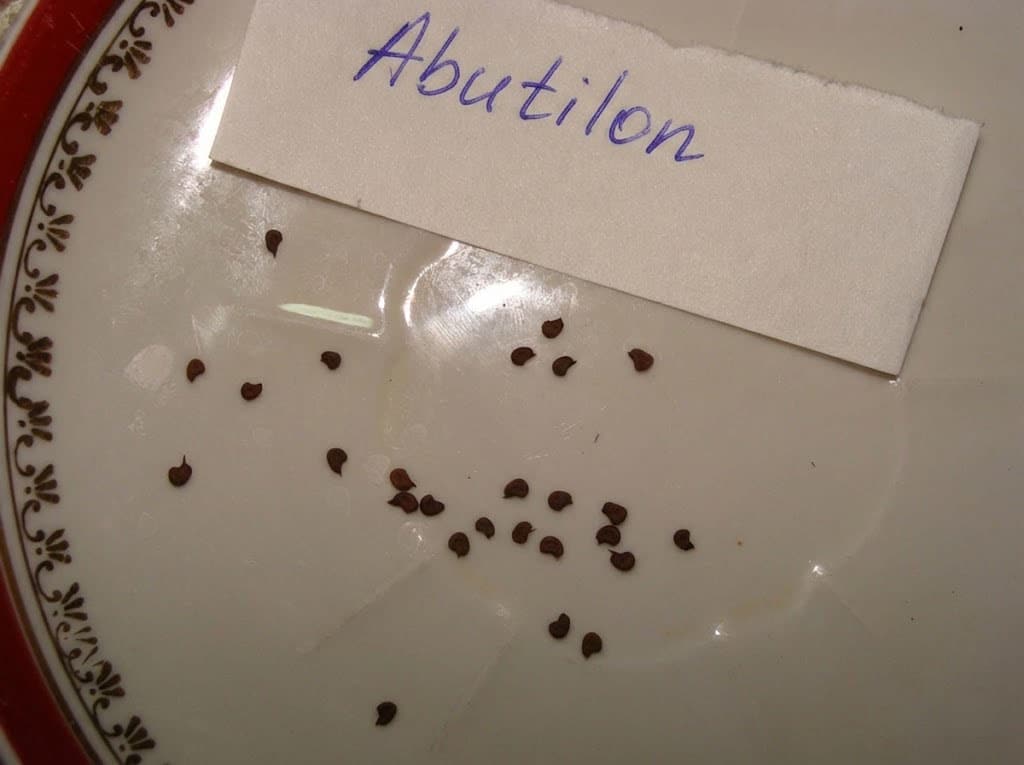


Spring is the best time to start Flowering Maple from seed. Here are the steps for seed propagation:
- Fill a shallow seed-starting tray with potting mix, scatter the seeds, and cover them with about 1/4 inch of soil.
- Moisten the surface with a spray bottle and place the tray in a well-lit, warm spot. Cover it with a piece of glass or a clear plastic humidity dome.
- While waiting for germination, periodically lift the cover to let fresh air in.
- Never let the soil dry out while the seedlings are developing. During their first week of growth, they will need bright light and extra heat (a seedling heat mat works great).
- Sprouts will typically appear within two to three weeks.
- Once the first set of true leaves appears, transplant the young maples into larger individual pots. The seedlings will stay in these pots for about 3 months until their roots fully fill the soil.


With proper care, your Abutilon will grow into a small bush during this time. It usually begins to bloom roughly 2 to 3 months after being moved into its larger pot.
Propagating from Cuttings
When you prune your Flowering Maple in the spring and fall, you’ll end up with plenty of plant material that can be quickly rooted to grow new plants. For rooting, use tip cuttings about 4 to 5 inches long. Here is how to grow Abutilon from cuttings:
- Take tip cuttings with a sharp, sterilized knife. Strip off the lower leaves, leaving only four leaves at the top. Cut the remaining leaves in half to reduce moisture loss.
- Make a 45-degree angle cut at the base of the stem. Dip the cut end into a rooting hormone (such as Clonex rooting gel, Hormex, or Garden Safe TakeRoot) according to the package instructions to stimulate root growth.
- Prepare a light rooting mix (like perlite and peat). Fill small plastic cups with the mix and moisten it.
- Use a pencil or chopstick to poke a hole in the soil. Insert the cutting into the hole, fill it in, and gently press the soil around the stem to secure it.
- Create a mini-greenhouse environment: cover the cups with a clear plastic bag or a glass jar. This helps trap humidity in both the air and the soil.
- Vent the mini-greenhouse daily, making sure that condensation doesn’t drip directly onto the cuttings.

Photos Submitted by Our Readers


Frequently Asked Questions (FAQ)
Flowering Maples can drop their leaves due to overwatering, sudden temperature fluctuations, or fertilizer burn (using too high a concentration of fertilizer).
According to US horticultural guides, Hybrid Abutilon (Abutilon x hybridum) and its cultivars—which are the most commonly grown varieties—are only winter hardy in USDA Zones 9–11. They cannot survive freezing temperatures (the absolute minimum is 32°F). It's best not to risk it; dig it up, repot it, and bring it indoors before the first frost.
The leaves will revert to a solid green color if the plant isn't getting enough sunlight. Move it to a brighter window to encourage the variegation to return.
If you plant a young Flowering Maple directly into a massive pot, it disrupts the balance between root development and top growth. The plant will focus entirely on filling the large volume of soil with roots before it pushes out any new foliage. As a result, for several years, you'll just have a small, sparse bush with no flowers. Up-potting gradually ensures healthy, continuous top growth and prevents the soil from staying too wet, which causes root rot.
A cool winter resting period isn't strictly mandatory. Flowering Maples can easily make it through the winter without going dormant. If kept at normal indoor room temperatures (around 65°F to 75°F), simply provide the plant with supplemental lighting (like an LED grow light) to keep it actively growing and happy.


